
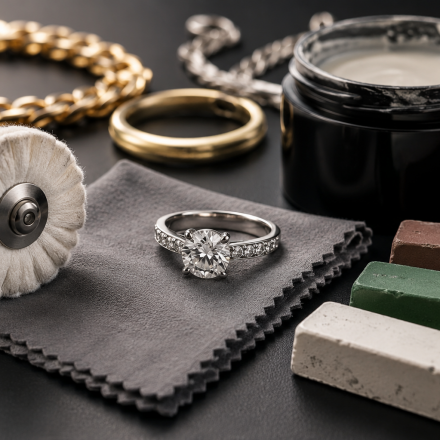
Most people would not know a poorly finished piece of jewellery by name, but they notice it immediately. A scratched surface, a flat finish, or an uneven sheen clearly indicates that the work has not been done properly. When you see a piece of jewellery with a clean, high-gloss finish even under close inspection, consider that it has been treated with the best jewellery polishing compound.
Compound choice affects not just the final appearance, but also how efficiently each stage of finishing runs and how long the surface condition lasts. This guide explains what to look for, which compound types suit which metals, and how professional finishing elevates both quality and durability.
What Makes a Jewellery Polishing Compound Suitable for Fine Metal Work
Polishing compounds are not interchangeable. The jewellery polishing compound needs to match the metal, the finishing stage, and the method of application, such as handwork, bench polisher, or machine work. A compound that works well on stainless steel cookware will not necessarily deliver the precision finish required for gold or silver jewellery.
The key factors that define a compound’s suitability for jewellery work are:
- Abrasive grade
Using the wrong grade at the wrong stage damages the surface rather than improving it. For example, cutting compounds are used for material removal. Brightness compounds are best for refining work.
- Metal compatibility
Some compounds are formulated for non-ferrous metals like gold, silver, and brass; others are designed for harder stainless or chrome surfaces
- Application format
Bar compounds are better suited to buffing wheel applications; paste formats are better suited to intricate handwork on settings, engravings, and fine detail areas.
Understanding the Different Types of Jewellery Polishing Compounds for Metal
Jewellery finishing is a staged process, and the sequence matters more than most people realise. A cutting compound does the heavy work first -removing surface flaws and preparing the metal. A brightness compound is used to build the final gloss. Trying to skip ahead or using the wrong jewellery polishing compound for metal at the wrong stage can leave imperfections.
Which compound works best at different stages of jewellery making:
| Compound Type | Primary Function | Stage of Use | Typical Application |
| Cutting compound | Removes scratches and surface imperfections | First -pre-polish | Initial surface preparation on raw or scratched metal |
| Cutting and brightness compound | Cuts and refines simultaneously | Mid-stage | Efficient single-step option for many jewellery metals |
| Brightness compound | Final polish to high gloss | Last -finishing | Gold, silver, platinum and fine detail work |
| Polishing paste (hand/machine) | Controlled polish for intricate surfaces | Detail finishing | Settings, engravings, filigree, and fine surface work |
How Metal Polishing Services Improve Surface Quality and Durability
A polished metal surface is more visually appealing and resistant to environmental degradation. Scratches and surface irregularities create microscopic points where moisture and contaminants can accumulate, accelerating tarnishing and corrosion over time. A properly polished surface removes those entry points, leaving a denser, smoother layer that is inherently less reactive to the environment.
In jewellery manufacturing and finishing, the quality of surface preparation also directly affects the performance of subsequent treatments. Plating, coating, and protective treatments all adhere better to a correctly finished substrate. Surface defects that are polished over rather than properly removed will eventually affect the product’s quality and longevity.
What Types of Metals Can Be Treated with Industrial Metal Finishing
Professional metal-finishing compounds are effective on a wide range of substrates. The metals commonly treated across jewellery, cutlery, cookware, and decorative manufacturing include:
- Gold and gold alloys: They require brightness compounds that are suited to softer, high-value metals where surface preservation is critical.
- Silver and sterling silver: These metals are tarnish-prone, but benefit from staged polishing that removes oxidation without thinning the metal
- Platinum: This hard, durable metal still requires appropriate compound selection to achieve a deep mirror finish.
- Brass and bronze: They are commonly used in costume jewellery and decorative fittings and respond well to cutting and brightness compound combinations.
- Stainless steel: It is used in contemporary jewellery and watch components. It requires compounds rated for harder surfaces.
How Metal Finishing Services Enhance Appearance and Corrosion Resistance
The visual outcome of a well-finished piece is a deep, consistent gloss that reflects light evenly across the surface. But the corrosion resistance benefit is equally significant for pieces intended to be worn, handled, or displayed over long periods.
Polishing removes the micro-scale surface irregularities where tarnish and corrosion start. When followed by an appropriate protective treatment or plating process, a correctly polished substrate holds that protection far more effectively than an unfinished one. For jewellery in particular, where pieces contact skin, perfumes, cleaning products, and moisture daily, this surface integrity determines how a piece maintains its condition between professional servicing.
The best jewellery polishing compound is essential for enhancing the sheen and beauty of jewellery. Using them in the correct sequence produces a result that hand-polishing with a single product simply cannot match.
Get the Right Finishing Products at Polyshine
At Polyshine, we supply the highest-quality compounds and finishing products that professional jewellers, manufacturers, and craftspeople rely on to achieve consistent results. Browse our full range by industry, surface type, or compound category on our website to find the product best suited for you. For guidance, reach out to our team, and we will assist you in selecting the best products.
Frequently Asked Questions
- What does a professional metal finishing supplier service include?
It includes abrasives, buffing wheels, and compounds matched to the metal and process. For jewellery, this involves cutting, refining, and brightness polishing stages. - How do metal polishing services improve surface quality and durability?
Polishing removes microscopic defects that cause tarnish and corrosion. This creates a smoother, denser surface that lasts longer and supports protective coatings. - When should manufacturers use a specialist metal finisher?
When high-quality surface finishes are essential, such as in jewellery or medical tools. Specialists ensure correct compounds and techniques for consistent results. - What metals can be treated with metal finishing services?
Metals include gold, silver, platinum, stainless steel, aluminium, brass, bronze, chrome, and nickel alloys. Each requires specific compounds for best results. - How do metal finishing services enhance appearance and corrosion resistance?
They create a smooth, high-gloss surface that reduces corrosion risk. This improves durability and keeps finishes looking new for longer.